The Role of Different Light Spectra on Various Plant Growth Stages
The Role of Different Light Spectra on Various Plant Growth Stages
Different light spectra (colors of light) play distinct roles in various plant growth stages, primarily related to photoreceptors within the plant (such as chlorophyll, phytochrome, cryptochrome, etc.).
Below is a detailed explanation of the effects of various light spectra on each stage of plant growth.
First, Understand Key Spectral Ranges and Their General Functions
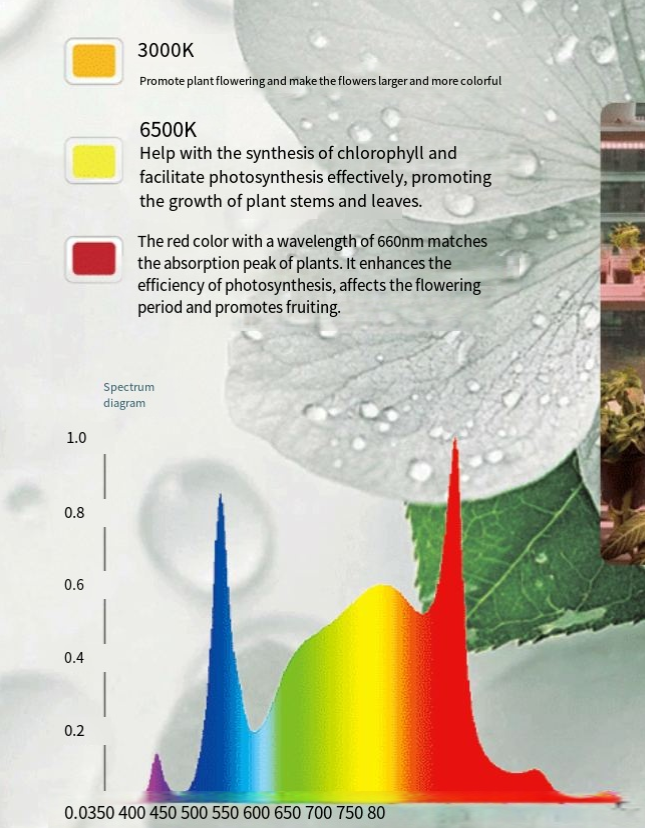
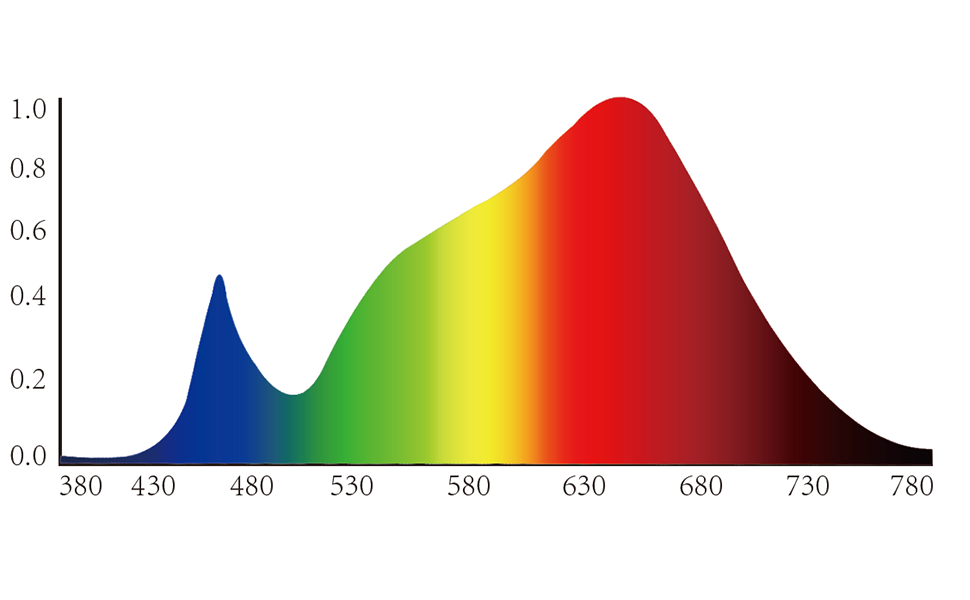
Blue Light (400-500 nm)
Function: Promotes vegetative growth. It controls stomatal opening, regulates photomorphogenesis (e.g., inhibiting internode elongation, preventing legginess), and promotes chlorophyll synthesis.
Simple Analogy: Blue light is like a “fitness coach” for the plant, making it grow more compact, sturdy, and with thicker leaves
Green Light (500-600 nm)
Function: Traditionally thought to be mostly reflected and less utilized However, recent research shows that green light can penetrate the canopy to provide light to lower leaves, promoting overall photosynthesis and regulating physiological responses in specific contexts.
Simple Analogy: Green light is a “coordinator,” helping to distribute light more evenly within the plant.
Red Light (600-700 nm)
Function: The most efficient spectrum for photosynthesis. It greatly promotes the synthesis and accumulation of carbohydrates and stimulates flowering and fruiting. It decisively influences photoperiod (flowering time).
Simple Analogy: Red light is the plant’s “energy engine” and “flowering signal.”
Far-Red Light (700-800 nm)
Function: Has an “antagonistic relationship” with red light. It primarily affects plant morphology, such as promoting stem elongation and controlling flowering time. A high proportion比例 of far-red light makes the plant think it’s in a shaded environment, causing it to grow taller to compete for sunlight.
Simple Analogy: Far-red light is the “grow tall command,” working with red light to regulate the plant’s “height” and flowering.
Ultraviolet Light (UV, 280-400 nm)
UV-A (315-400 nm): Has a minor impact on plant morphology; some studies suggest it can trigger plant resistance UV-B (280-315 nm):
An environmental stressor. In low doses, it can stimulate plants to produce more antioxidants like flavonoids and anthocyanins, resulting in more vibrant flower colors, richer fruit flavors, and enhanced disease resistance However, excessive amounts can scorch the plant.